
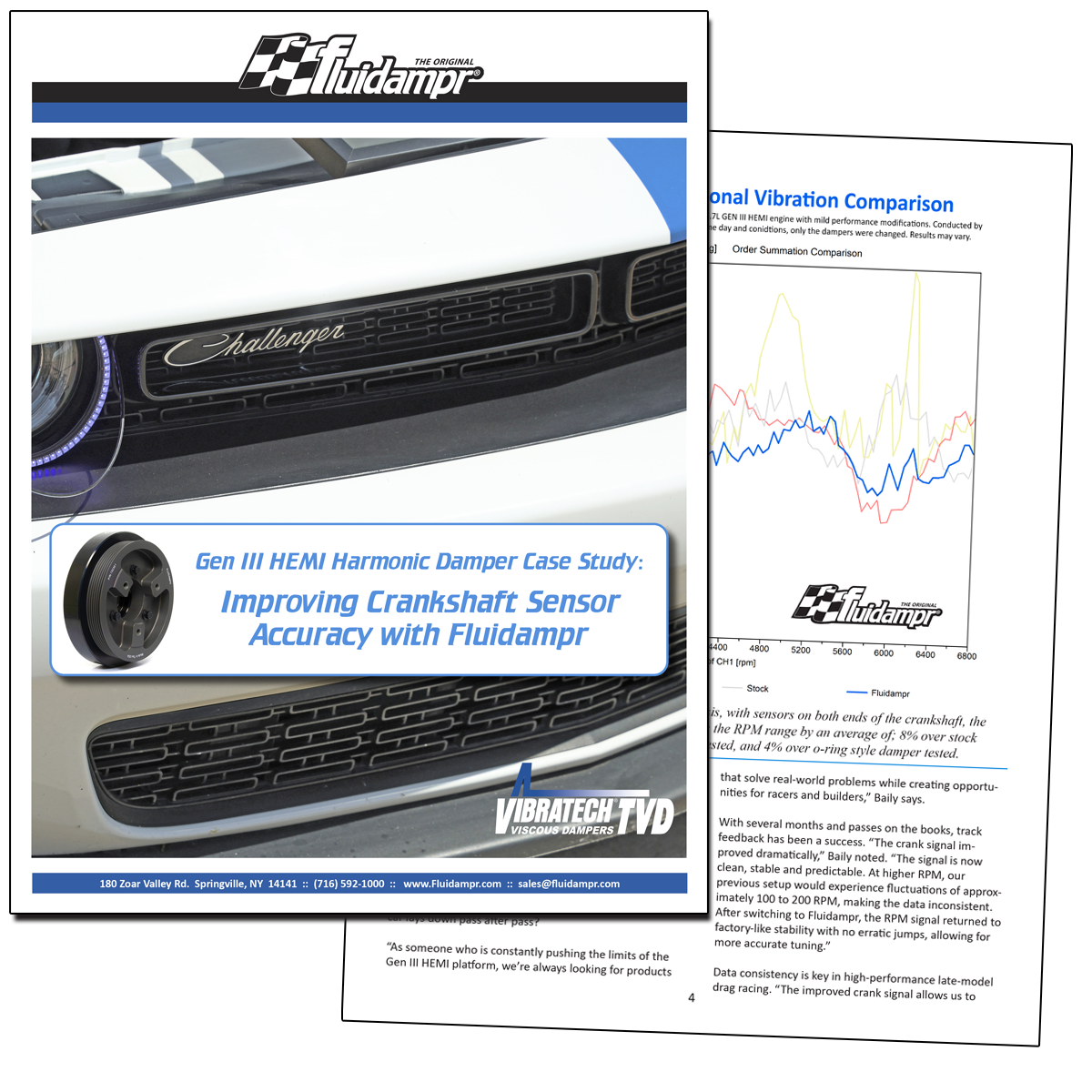
From Crankshaft Signal Problem to Production-Ready Solution
When a high-performance engine builder encountered unstable crankshaft position sensor data, excessive torsional vibration was suspected. Solving the problem required more than selecting a different harmonic damper. It required engineering analysis, prototype development, instrumented dyno testing and real-world validation.
This case study follows the complete development process as Vibratech TVD worked with motorsports partners to understand the application, establish design requirements, compare damper technologies and validate performance through OEM-level torsional vibration analysis.
The resulting solution reduced average crankshaft deflection across the RPM range compared with each damper tested. After track validation on a 2,800-horsepower Gen III HEMI, the engine builder reported that previous 100–200 RPM signal fluctuations returned to factory-like stability, providing consistent data for RPM-based control strategies and engine tuning.
Inside the Case Study
- How crankshaft torsional vibration can affect sensor data and engine tuning
- The engineering process behind harmonic damper development
- How torsional vibration was measured using sensors at both ends of the crankshaft
- Comparative dyno testing against multiple damper technologies
- Real-world validation on a 2,800-horsepower racing application
- The transition from prototype development to volume production
- Practical Engine Builder Notes and technical FAQs